
He Was Arrested for Filming the PSA 182 Crash. The Lawsuit That Changed California Press Access.
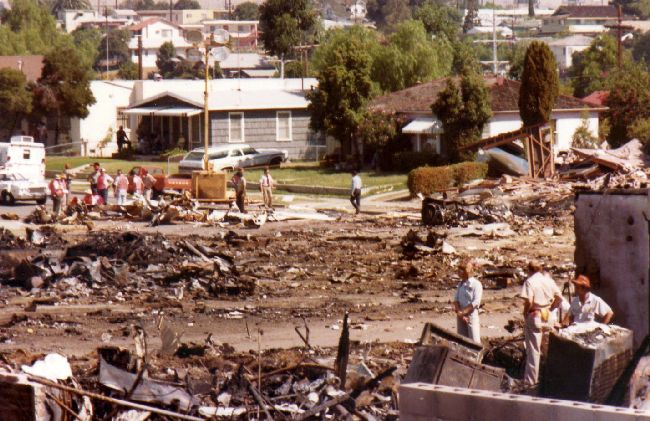
Photo: San Diego Air & Space Museum Archives, Catalog #06-01569. Source: Wikimedia Commons / SDASM Flickr. No known copyright restrictions.
Photo: San Diego Air & Space Museum Archives, Catalog #06-01569. Source: Wikimedia Commons / SDASM Flickr. No known copyright restrictions.
On the morning of September 25, 1978, PSA Flight 182 collided with a Cessna over North Park and came down in the neighborhood around Dwight and Nile Streets. Everyone aboard both aircraft was killed, along with several people on the ground. It remains one of the darkest days in San Diego history.
Within minutes, KFMB-TV Channel 8 cameraman Steven Leiserson was on scene filming the wreckage and the rescue effort. He worked the site for about half an hour, and no one ever testified that he got in anyone’s way or disturbed anything. Then an SDPD officer ordered him out. Leiserson said he had a right to be there and asked for the officer’s badge number. After a second warning he kept working, walked past a volunteer handling crowd control, and was arrested for disobeying a lawful order. He was booked into county jail.
The criminal charge was dismissed. Leiserson then sued the City, and his case became the leading California decision on press access at disaster scenes: Leiserson v. City of San Diego (1986) 184 Cal.App.3d 41.
The Law
Penal Code 409.5(a) allows police to close an area when a calamity like a fire, flood, crash, or explosion creates a threat to public safety. Subdivision (d) carves out the press. Nothing in the section prevents a duly authorized representative of a news service, newspaper, or radio or television station from entering the closed area. The tape line that keeps the public out does not apply to the press.
What the Court Decided
The City offered three reasons for removing Leiserson, and the Court of Appeal rejected two of them.
The first was danger. The court pointed out that police can only close a disaster area because it is already dangerous, so the press exemption assumes the hazard exists. The Legislature decided the public’s right to know outweighs that risk. Officers can warn journalists, but they cannot keep them out on safety grounds alone.
The second was the press area. SDPD had set up a staging area about 60 feet from the wreckage, but no one told Leiserson it existed. The court held that the press must be given unrestricted access to disaster sites unless officers reasonably determine that such access will interfere with emergency operations. Even then, any restriction can only go as far and last as long as needed to prevent that interference, and the press is still entitled to the most access possible.
The third reason is the one that sank Leiserson’s case. A sergeant testified that two CHP officers told him the Lieutenant Governor may have been aboard and that a bomb might have brought the plane down. The story was false, the officers were never identified, and the court said openly that it suspected the claim was at least partly an after-the-fact justification. Still, it deferred to the trial judge, and crime scenes can be closed to everyone, press included. Leiserson lost.
He also fought largely alone. His own station, the Press Club, SPJ, and the ACLU all declined to back him. He lost his damages claim and, two years later, his bid for attorney’s fees.
Why It Still Matters
Leiserson lost his case, but the rule the court wrote is still law. In 1981, SDPD rewrote its media policy to say that disaster scenes may be closed to the public while news media are exempt and must be given free access once the scene is secured. The 1977 policy it replaced never mentioned 409.5.
The case settled several points. The press can enter disaster and accident areas that are closed to the public. Danger alone does not justify keeping journalists out. A press staging area only satisfies the law if it is the most access possible without interfering with emergency work, and only if you are actually told about it. The limits are just as clear. Police can close a reasonably suspected crime scene to everyone, and interfering with rescue or fire operations is not protected.
Know Your Rights, and Know Their Limits
Leiserson was right about the law and still spent the day in jail and years in court. Knowing your rights means knowing both sides of that line.
Know the code section by number. The officers who arrested Leiserson had never heard of 409.5, and calmly citing “Penal Code 409.5(d)” on scene carries more weight than an argument. Know the exceptions, because a crime scene or actual interference changes everything. Document names, badge numbers, times, and exactly what was said. Ask where the press area is, and note it if no one can tell you, since that detail mattered in court. Above all, fight it on paper afterward rather than on the pavement. Leiserson won the legal argument in the published opinion and still lost his case because of a single order and a single exception.
The law has moved forward since then, too. Penal Code 409.7, added by SB 98 in 2021, specifically protects journalists covering protests and demonstrations, and it is worth reading alongside 409.5.
Taking Our City Back
In 1978, one cameraman stood alone. His station walked away from him and so did the organizations that were supposed to defend the press. He pushed anyway, far enough that the courts had to answer the question and SDPD had to rewrite its policy.
We don’t have to stand alone. We have scanners, cameras, open data, and each other. The public’s right to know what happens on our streets was never a gift from the City. People like Leiserson fought for it, and it only stays real if we use it, know it, and defend it.
Learn the law. Carry it with you. Show up, document everything, and back each other up. This is our city, and these are our rights.
This piece was researched and drafted with AI from an outline by our editor, who made the editorial calls, checked the sources and edited it. How we use AI, and where we draw the line: sdslackers.com/how-sd-slackers-uses-ai


